

Overview
A China semi trailer is a trailer manufactured in the People’s Republic of China for domestic use or export, produced across a manufacturing landscape that ranges from massive state-linked conglomerates to small regional workshops. Procurement managers and fleet buyers sourcing from China encounter a market where the country is the world’s largest semi-trailer producer by volume, yet the quality and compliance of individual units vary as widely as the factories that build them.
The procurement problem is not whether China can build semi trailers—CIMC has been the world’s largest semi-trailer manufacturer by sales volume every year since 2013 , and the Shandong cluster alone contains dozens of large manufacturers . The problem is distinguishing a factory with verifiable production capability and export documentation from a trading company or a workshop whose trailers may not meet the destination market’s safety standards. This FAQ addresses the manufacturing landscape, the certification framework, the quality risks documented in the domestic market, and the verification steps that determine whether a China semi trailer procurement is sound.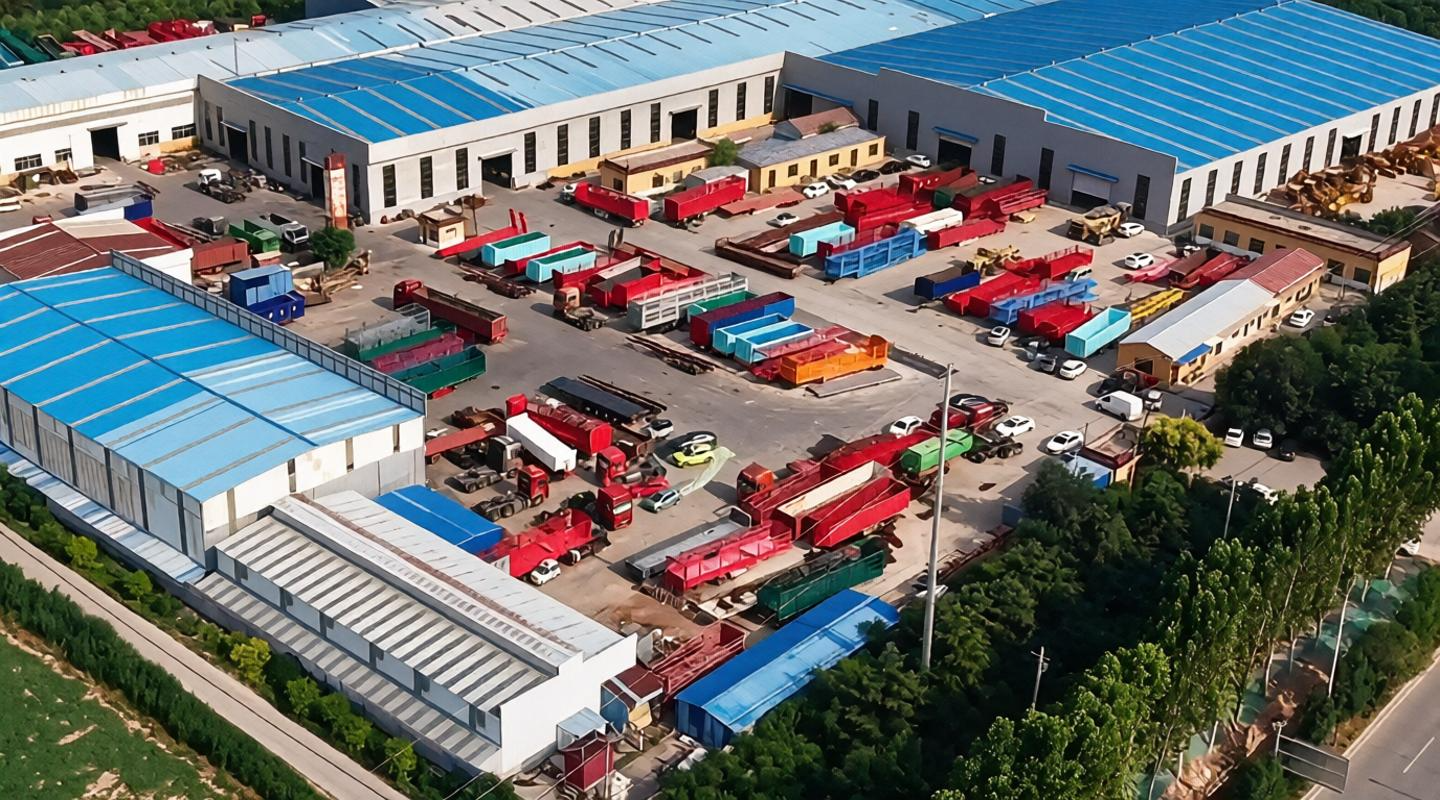
Frequently Asked Questions
What does the China semi trailer manufacturing landscape look like?
China’s semi trailer manufacturing landscape is dominated by CIMC (China International Marine Containers) and its subsidiaries, with a dense cluster of independent manufacturers concentrated in Shandong province’s Liangshan County. CIMC began manufacturing semi-trailers in 2002 and has been the world’s largest semi-trailer manufacturer by total sales volume every year since 2013 . IndexBox’s manufacturer directory lists dozens of large producers in Jining, Shandong alone, many operating under the CIMC group umbrella or as independent regional manufacturers . Outside Shandong, major producers include CIMC Huajun in Henan, which reported 24 billion yuan in comprehensive revenue in 2025 with 40% from overseas markets, and export orders booked through June 2026 . The landscape is stratified: the top tier has automated production lines, patent portfolios, and international certifications; the bottom tier is small workshops with limited quality control.
What certifications should a Chinese semi trailer factory hold?
A Chinese semi trailer factory should hold ISO 9001 quality management certification and CCC (China Compulsory Certification), with additional certifications depending on the export market. CHENLU Trailer, a Shandong-based exporter, holds ISO 9001:2015 (certificate no. 10424Q02039ROM) and CCC (certificate no. 2020091101021746), and states that buyers should verify certificate numbers rather than accepting a logo on a website . For Russian markets, OTTC certification is required; AOTONG lists OTTC compliance among its credentials . For Australian markets, the trailer must meet Australian Design Rules and may require compliance plate approval. The critical procurement check is that the certificate applies to the exact model being purchased, not merely to the factory’s general production.
What quality risks exist in the Chinese semi trailer market?
The most documented quality risk in the Chinese semi trailer market is brake system non-compliance, particularly counterfeit or substandard ABS units. A 2026 investigation by Truck Home (卡车之家) at the Xinfadi market found that over 90% of semi trailers on Chinese roads had non-compliant brake systems, with the core issue being the prevalence of fake ABS products—including so-called “registration ABS” designed to pass vehicle inspection while providing no real anti-lock function . The consequences documented include trailer tail-swing during highway driving in rain and abnormal tire wear. The investigation notes that many drivers have never experienced a compliant ABS system and may modify their trailers with “brake king” devices that further degrade safety . For an export buyer, this means the brake system specification—ABS brand, EBS availability, and certification—must be verified independently, not assumed from the trailer’s general condition.
How large is the price advantage of a China semi trailer?
A China semi trailer typically prices at 30% to 60% below a comparable North American or European unit on an FOB basis, but the landed cost gap narrows after freight, duties, and compliance costs. LuckSun’s 2026 export price guide lists basic semi trailers starting below **$10,000 FOB**, with container skeleton trailers at **$6,500–$15,000**, flatbeds at **$7,000–$18,000+**, lowbeds at **$8,000–$35,000+**, and tankers at **$15,000–$55,000+** depending on material and specification . By comparison, new North American flatbeds list at **$41,000–$45,000**, and reefers can exceed **$60,000–$100,000** . The FOB price excludes ocean freight, insurance, port charges, customs duties, inland transport, and local compliance costs—the guide explicitly states that a $12,000 FOB trailer does not mean the buyer’s final cost will be $12,000 .
How should an export buyer verify a Chinese semi trailer factory?
An export buyer should verify a Chinese semi trailer factory through a live video walkthrough of the production line, verification of the business license against the factory address, and a third-party pre-shipment inspection before final payment. CHENLU advises buyers to “ask for proof of production, not just photos,” and notes that a factory can show its workshops and welding lines on a live video call . The factory’s business license should list manufacturing as its scope, not trading. A pre-shipment inspection should verify the main beam dimensions, axle brand and rating, brake system components, tire date codes, and the presence of the specified certifications. The inspection cost is small relative to the risk of receiving a trailer with substituted components or non-compliant brakes.
What axle and component brands are available on Chinese semi trailers?
Chinese semi trailers are available with imported premium brands (BPW, SAF-HOLLAND, Hendrickson), domestic major brands (Fuwa, Fengbao), and factory-owned axle brands, with the choice affecting both price and parts availability. BPW operates a manufacturing facility in Meizhou, Guangdong, and holds a significant share of China’s high-end trailer axle market, particularly in hazardous materials, precision instrument transport, and refrigerated applications . SAF-HOLLAND manufactures in Yangzhou with a designed annual capacity of 200,000 axles . Fuwa (Guangdong Fuwa) is the leading domestic brand, and Fengbao is a major northern Chinese axle manufacturer . CIMC and Luoxiang operate their own axle brands (Benjiu Tengyue and Zhongqi Axle respectively) . For export buyers, BPW and Fuwa offer the broadest international parts networks; factory-owned brands may require sourcing from the original manufacturer.
What are the production and shipping timelines for a China semi trailer export?
Production timelines for a China semi trailer export typically run 10 to 30 days after deposit for custom builds, with standard models potentially available from stock . CIMC Huajun’s “Starlink” production line has compressed its delivery cycle to 7 to 15 days . Shipping is arranged by RO-RO (roll-on/roll-off vessel), bulk vessel, 40HQ container (for partially disassembled units), or flat rack, with ocean transit time depending on the destination port . The buyer should confirm whether the quoted price is EXW, FOB, CFR, or CIF before comparing suppliers, because the Incoterm determines who bears the freight and insurance cost . Export documents should include the commercial invoice, packing list, bill of lading, and certificate of origin, with additional documents depending on the destination country’s customs and registration requirements .
Conclusion
Sourcing a semi trailer from China is a factory verification and specification-control exercise, not a price comparison. Confirm the factory’s production capability through a live audit and business license verification, require ISO 9001 and CCC certificates that apply to the exact model, and independently verify the brake system—the component where the domestic market’s quality gap is most documented. The CIMC-scale producers and the Shandong export factories can deliver compliant trailers with international component brands; the risk lies in the segment of the market where certificates are decorative and ABS units are “registration only.” The buyer who inspects the factory and specifies the brake brand is the one who receives a trailer that enters service without a compliance or safety problem.