

Overview
OHSAS 18001 certified excavators meet rigorous occupational health and safety management standards, ensuring reduced operational risk and compliance for B2B fleets. Below are technical answers to high-intent procurement and maintenance questions.
Frequently Asked Questions
Q1: What is the standard maintenance interval for an OHSAS 18001 excavator under normal operating conditions?
The standard maintenance interval is every 250 operating hours or monthly, whichever comes first, for OHSAS 18001 compliant excavators. This includes engine oil change, filter inspection, and lubrication of pivot points. For severe duty (high dust, demolition, or extreme temperatures), reduce intervals to 150 hours. Always follow the OEM safety lockout/tagout procedures required by OHSAS 18001 before any service.
Q2: What is the maximum payload capacity of an OHSAS 18001 certified excavator in the 20-ton class?
The maximum payload capacity is typically 18,500 kg to 21,000 kg (40,785 to 46,297 lbs) for a 20-ton class OHSAS 18001 excavator, depending on counterweight configuration and boom arm geometry. Critical factors include lift point height (at 4.5m, capacity drops ~30%) and swing radius. Always consult the machine's load chart – OHSAS 18001 requires that chart be legible and mounted in the cab. For safety compliance, never exceed 85% of rated capacity on uneven terrain.
Q3: What are the engine emissions standards for OHSAS 18001 excavators in regulated markets?
OHSAS 18001 excavators sold in the EU and North America must meet Tier 4 Final or Stage V emissions standards, featuring diesel particulate filters (DPF) and selective catalytic reduction (SCR). These engines produce NOx levels below 0.4 g/kWh and particulate matter under 0.02 g/kWh. The OHSAS 18001 certification itself does not set emissions limits but mandates that all exhaust systems be fully sealed and operator breathing zones monitored during prolonged use in tunnels or confined spaces.
Q4: How often should hydraulic fluid be replaced in an OHSAS 18001 excavator?
Hydraulic fluid replacement interval is every 2,000 operating hours or annually, whichever occurs sooner, for OHSAS 18001 compliant excavators using premium AW46 or biodegradable hydraulic oil. The OHSAS 18001 standard requires a hydraulic oil analysis every 500 hours to check for water content (below 0.1%), ISO cleanliness code (target 18/16/13), and viscosity degradation. If analysis shows contamination or oxidation, replace immediately – not doing so voids safety certification for hydraulic circuit integrity.
Q5: What attachment compatibility does an OHSAS 18001 excavator have for hydraulic breakers and augers?
The OHSAS 18001 excavator is compatible with all ISO 11852 quick coupler attachments, including hydraulic breakers (500-2000 ft-lb class), augers (6-36 inch diameter), and compaction wheels. Critical compatibility requirements: auxiliary hydraulic flow must match attachment demand (typically 30-60 gpm at 3,000-4,500 psi). OHSAS 18001 adds mandatory safety interlocks – the attachment cannot receive flow unless the cab door is closed and the operator is seated. Always verify pin-on or wedge coupler type from OEM.
Q6: Where can I source certified spare parts (undercarriage, pumps, seals) for an OHSAS 18001 excavator?
Certified spare parts must be sourced from OEM authorized distributors or ISO 9001:2015 suppliers who provide traceable material certificates and OHSAS 18001-compliant safety data sheets. Critical wear parts – track chains, sprockets, hydraulic pumps, and cylinder seals – require full lot traceability. Do not use aftermarket parts without a declaration of conformance to the original safety specifications, as this voids the excavator's OHSAS 18001 management system certification. Common part numbers: track shoes (300mm triple grouser), main pump (K3V112DT), and swing bearing seal kit (OK-8840).
Q7: What pre-sales documentation is required for an OHSAS 18001 excavator to meet fleet safety compliance?
Required pre-sales documentation includes the OHSAS 18001 certificate of conformance, factory risk assessment report (FMEA), declared noise levels (LpA ≤ 78 dB(A) at operator ear), and vibration emission values (hands-arm ≤ 2.5 m/s², whole-body ≤ 0.5 m/s²). Additionally, a lockout/tagout procedure manual, hydraulic system schematic with pressure ratings, and a validated rollover protective structure (ROPS) test report must be provided. Without these, the machine cannot be integrated into an OHSAS 18001-managed fleet.
Q8: How does OHSAS 18001 certification affect daily pre-start inspection checklists?
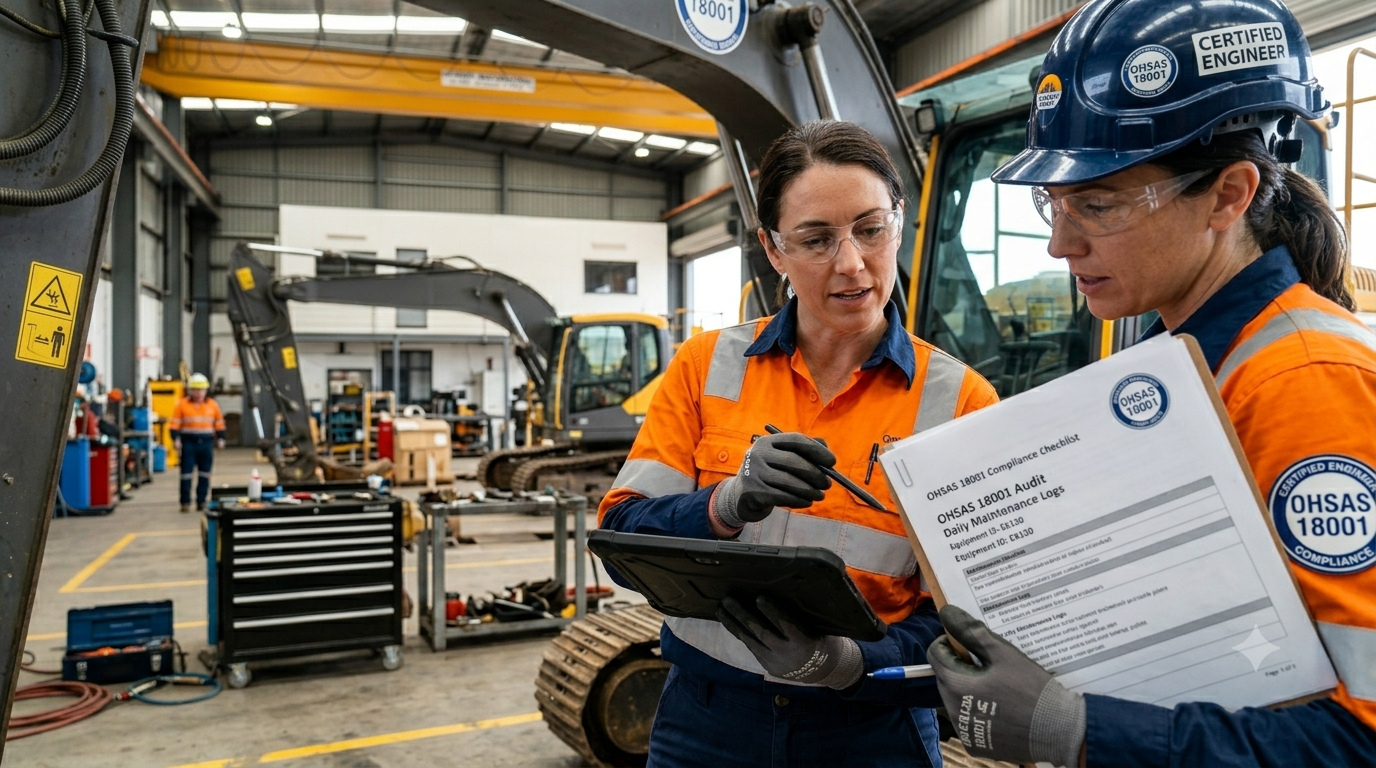
The OHSAS 18001 certification requires a 12-point daily pre-start checklist that exceeds standard manufacturer recommendations. Mandatory items include: hydraulic hose abrasion inspection (replace if any cord showing), backup alarm function test, fire extinguisher seal check, seatbelt condition and anchor torque, emergency egress path clearance, and cabin air filter integrity (to prevent respirable silica or diesel particulate exposure). This checklist must be signed digitally or on paper and retained for a minimum of 3 years per OHSAS documentation control requirements.