

Introduction
Semi trailer jack stands are fixed or adjustable support devices placed under the front or rear of an uncoupled trailer to prevent it from tipping forward or collapsing during loading, unloading, or maintenance. They are distinct from the landing gear that is permanently attached to the trailer: landing gear is designed for normal parking and coupling, while jack stands provide supplementary or temporary support when the trailer is subjected to unbalanced loads—such as a forklift entering the deck—or when maintenance work requires the trailer to be raised and secured.
The operational pressures around jack stand selection are safety-critical. An uncoupled trailer resting only on its landing gear can upend if a heavy load moves forward during loading, because the landing gear is not designed to resist that forward tipping moment. OSHA regulation 1910.178(k)(3) explicitly recognizes this hazard, stating that fixed jacks may be necessary to support a semi trailer and prevent upending during loading or unloading when the trailer is not coupled to a tractor . For maintenance work, the stakes are even higher: OSHA has cited employers for allowing workers under vehicles supported by wood blocks or inadequate jacks instead of proper jack stands, exposing them to struck-by hazards from vehicle collapse .
This guide examines the engineering and commercial factors that define semi trailer jack stand selection: capacity ratings and their meaning, height range requirements, safety standards and regulatory context, and the application scenarios that determine which type of stand is appropriate.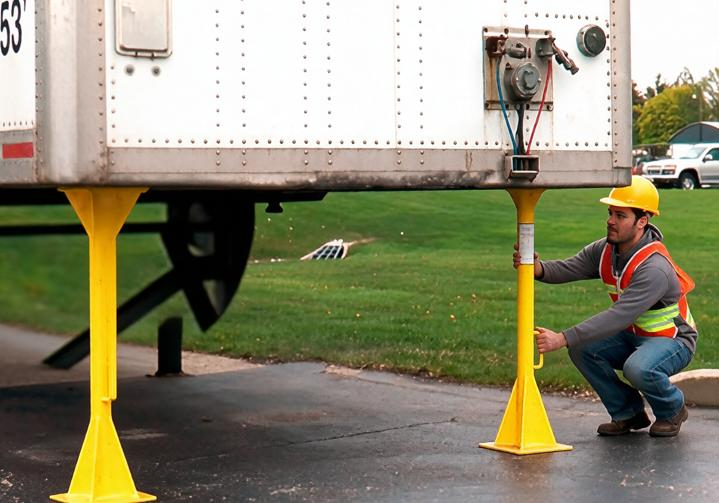
Core Powertrain and Structural Design
Engine and Transmission
Semi trailer jack stands have no relationship to the tractor’s engine or transmission. They are passive support devices whose performance is defined by their structural capacity, height adjustment range, and base stability. The relevant engineering parameters are static load capacity, lifting capacity (where applicable), and the material and construction of the load-bearing components.
Hydraulic System
Most semi trailer jack stands are mechanical devices—screw-adjustable or ratchet-adjusted—and do not use hydraulic systems. Hydraulic jacks are used to raise the trailer, but the jack stand is the device that holds it in the raised position while work is performed. This distinction is important: a hydraulic jack is a lifting tool, not a support device, and should never be relied upon to hold a load while someone is underneath. OSHA citations have specifically penalized employers for using only a jack without a stand, or for using air bag suspension components to elevate a trailer for repair without adequate support .
Chassis and Structural Durability
The base design is the primary stability factor. A wide, flat base distributes load over a larger floor area and resists tipping under eccentric loads. Some models use a round dome-shaped base, while others use a flat base or a pyramid base. The stand’s saddle—the top surface that contacts the trailer—must be shaped to grip the contact point securely without slipping. Notched or shaped saddles are preferred over flat tops because they locate the load and prevent lateral movement.
Height adjustment mechanism varies by design. Screw-type stands use an acme-threaded screw for precise height setting, while ratchet-type stands use a toothed rack and pawl for quick adjustment. Screw stands are generally preferred for semi trailer applications because they allow fine height matching to the trailer’s frame or axle and are less prone to inadvertent release under load. The adjustment range must be sufficient to reach the trailer’s support point from the ground; a stand that cannot reach the frame is useless regardless of its capacity.
Technical Specifications
The table below presents representative parameters for semi trailer jack stands across common configurations. Values are drawn from published product specifications and regulatory references; actual requirements vary by trailer type, load condition, and application.
| Key Parameter | Typical Technical Specification | Operational Significance |
|---|---|---|
| Static capacity (dock/loading support) | 50,000 lb (22.7 t) typical for semi trailer stabilizing jacks | Must exceed the maximum load the trailer will impose on the stand during loading or parking |
| Lifting capacity (where rated) | 5,000 lb (2.3 t) typical for hand-crank models | Indicates the force the mechanism can apply to raise a load; not the same as static holding capacity |
| Height adjustment range | 41–55 in (1.04–1.40 m) for dock stands; 35–55 in for adjustable models | Must span the distance from ground to the trailer’s frame or support point |
| Base type | Round dome, flat, or pyramid; wide diameter for stability | Larger contact area reduces floor pressure and tipping risk on uneven surfaces |
| Adjustment mechanism | Screw (acme thread) or ratchet | Screw allows precise height setting; ratchet offers faster adjustment |
| Construction material | All-steel, welded; powder-coated finish | Must resist deformation under static load and corrosion in outdoor storage |
| OSHA reference | 1910.178(k)(3) — fixed jacks may be necessary to prevent upending | Regulatory basis for using jack stands on uncoupled trailers during loading |
| Wheel configuration | None (fixed), or semi-pneumatic/hard rubber for portability | Wheels aid positioning but must be chocked or stable once load is applied |
Comparative Advantages TCO and ROI
The jack stand decision is a safety and liability decision more than a cost decision. A basic semi trailer stabilizing jack stand may cost a few hundred currency units, while the consequences of a trailer upending or collapsing during loading or maintenance include injury, fatality, cargo damage, trailer structural damage, and regulatory penalties. The cost of a proper stand is trivial against the cost of a single incident.
The comparison between using landing gear alone and supplementing with jack stands is not a matter of convenience. Landing gear is designed for vertical load support during parking and coupling. It is not designed to resist the forward tipping moment created when a heavy load—such as a forklift and its operator—enters the trailer deck while the trailer is uncoupled. OSHA’s recognition of this hazard in 1910.178(k)(3) reflects the engineering reality: an uncoupled trailer supported only at the rear axles and the landing gear has a limited resistance to forward overturning, and a jack stand placed under the front frame or nose provides the additional support point that prevents it .
For maintenance applications, the comparison is between proper jack stands and improvised support. OSHA citations document employers penalized for using wood blocks under tires, air bag suspension as a lifting device, or a single jack stand under a vehicle being worked on . The cost of a set of adequate-capacity stands is negligible against the penalty for a serious violation, and the safety difference is absolute.
A defensible cost comparison requires stated assumptions. Consider a terminal that handles 20 trailer loads per day with a forklift entering each trailer. If the terminal uses one jack stand per loading position at a cost of 2,000 CNY each, and the stands last five years, the annualized cost is 400 CNY per position. Against this, the liability exposure from a single trailer upending incident—even without injury—includes cargo damage, trailer repair, production disruption, and potential OSHA penalties that can reach thousands of currency units per violation. The stand pays for itself the first time it prevents a trailer from tipping, and it represents compliance with a recognized safety practice every day it is in use.
Heavy Duty Application Scenarios
-
Loading dock operations: The most common application for semi trailer jack stands. When a trailer is spotted at a dock and the tractor is uncoupled, a jack stand placed under the front frame prevents upending as a forklift enters and exits. Static capacity must exceed the maximum load the trailer will impose, and the stand must be placed on a flat, stable surface—preferably concrete .
-
Maintenance and repair work: Jack stands support the trailer while wheels, brakes, suspension, or undercarriage components are serviced. The stand must be rated for the load it supports and placed under a structural member—frame rail or axle—not under a non-structural component. OSHA requires that the jack used to raise the vehicle have sufficient capacity, and that jack stands be placed under the vehicle once elevated .
-
Trailer storage and staging: Trailers parked for extended periods may benefit from supplementary support to reduce load on landing gear and tires. The stand must be placed on stable ground and adjusted to contact the frame without lifting it, so that the landing gear retains its share of the load.
-
Roadside and remote repairs: Portable jack stands with wheels or carrying handles allow positioning at remote locations. However, roadside repairs require particular attention to ground stability and to using stands of adequate capacity for the load, as the consequences of a collapse on an unlevel shoulder are severe.
Selection and Maintenance Considerations
Selecting semi trailer jack stands begins with the application: is the stand for loading dock support, maintenance support, or storage? The application determines the required capacity, height range, and features.
Key selection and maintenance considerations include:
-
Match static capacity to the maximum load. The stand’s static capacity must exceed the load it will support, with margin for dynamic effects during loading. A 50,000 lb static capacity stand is appropriate for supporting the nose of a loaded semi trailer during dock operations . For maintenance support under an axle, the capacity must exceed the load on that axle.
-
Verify height range against the trailer’s support point. Measure the distance from the ground to the frame or axle at the intended support location. The stand must reach that height with adjustment range to spare, and must not be extended to its maximum limit where stability is reduced.
-
Use a stand with a shaped or notched saddle. A flat top allows the trailer frame to slide under load or vibration. A shaped saddle locates the contact point and resists lateral movement.
-
Place the stand on a firm, level surface. Concrete or paved surfaces are preferred. On soft ground, the stand may sink or tip. OSHA guidance and manufacturer instructions specify flat, stable surfaces for jack stand use .
-
Inspect stands before each use. Check for bent or cracked components, worn threads on screw stands, damaged ratchet teeth, and corrosion that reduces section thickness. A stand that has been overloaded or dropped should be inspected by a qualified person before returning to service.
-
Never rely on a jack alone. A hydraulic or mechanical jack is for lifting, not for holding. Once the trailer is raised, place jack stands under structural members before any work begins .
Conclusion
Semi trailer jack stands are a small component in the fleet maintenance budget with an outsized role in safety and compliance. The engineering priorities are clear: select a stand with static capacity exceeding the maximum load, a height range that reaches the trailer’s support point, and a base and saddle design that resist tipping and slipping. The regulatory priority is equally clear: OSHA 1910.178(k)(3) recognizes that uncoupled trailers may require fixed jacks to prevent upending during loading, and OSHA enforcement actions consistently penalize improvised support and reliance on jacks without stands .
Commercially, the jack stand decision is a liability decision. The cost of adequate stands is trivial against the cost of a trailer collapse, a maintenance injury, or a regulatory penalty. Fleets and terminals that equip every loading position with a proper stand, train operators to place it correctly, and inspect stands before each use achieve a safety record that improvised support cannot match. The stand that is in place before the forklift enters the trailer is doing the job the regulation intended—protecting the people and assets that depend on the trailer remaining upright.