

Overview
Semi trailer weight distribution is the practice of positioning cargo so that the load on each axle—steer, drive, and trailer—stays within legal limits and the combination remains stable at highway speed. For fleet managers and drivers, the problem is that a trailer can be under the 80,000 lb gross limit and still be illegal, because the weight is concentrated on one axle group or violates the federal Bridge Formula that governs weight-to-length ratios on the Interstate System .
The consequences of poor distribution are both legal and physical. An overloaded steer axle degrades steering control; an overloaded trailer tandem triggers fines and out-of-service orders; and a rear-heavy load produces trailer sway that can overpower the tractor in a crosswind or panic stop. This FAQ addresses the axle limits, the Bridge Formula, and the loading practices that determine whether a load is both legal and safe.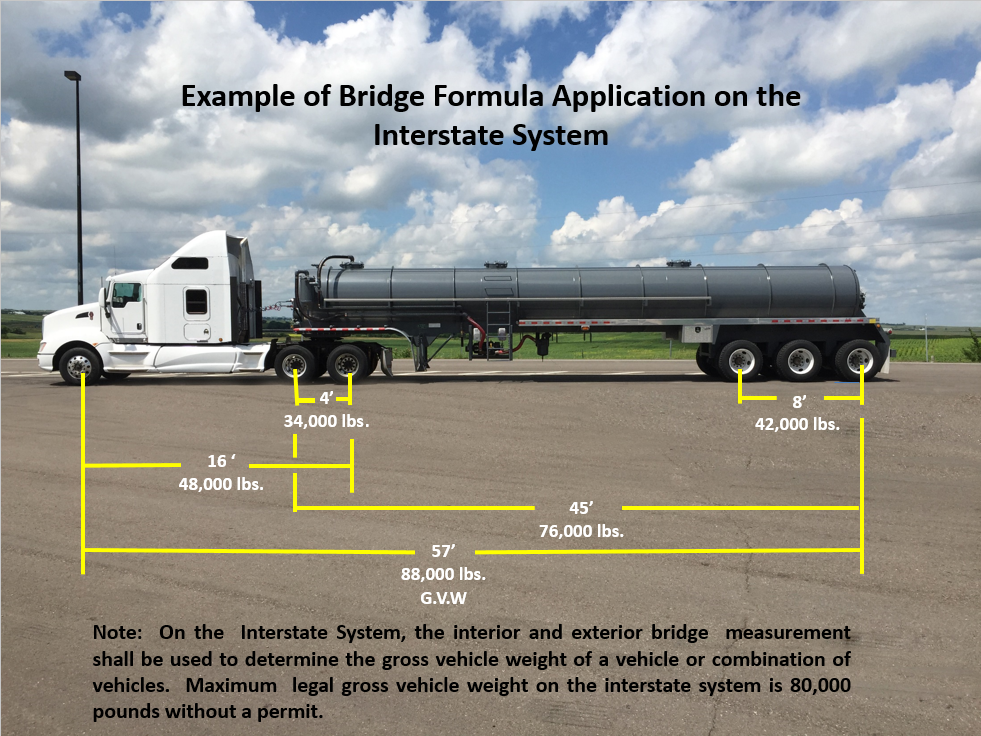
Frequently Asked Questions
What are the legal axle weight limits for a semi trailer?
The federal limits on the Interstate System are 20,000 lb for a single axle, 34,000 lb for a tandem axle group, and 80,000 lb gross vehicle weight for the combination . These are the baseline limits; some states have grandfathered higher limits, and the Bridge Formula can impose a lower limit than the gross cap depending on axle spacing.
A typical five-axle tractor-trailer distributes the 80,000 lb approximately as 12,000 lb on the steer axle, 34,000 lb on the drive tandems, and 34,000 lb on the trailer tandems . The trailer’s share is not fixed; it depends on how the load is positioned relative to the trailer axles and how much weight the fifth wheel transfers to the tractor’s drive axles. The trailer data plate and the state weight regulations for the operating route control the specific limits.
What is the Bridge Formula and why does it matter?
The Bridge Formula is a federal weight-to-length rule that limits the weight any group of consecutive axles can carry based on the distance between the outer axles of that group . It exists because a short, heavy vehicle concentrates stress on a bridge differently than a long vehicle carrying the same total weight; spreading the weight over more distance reduces the load on any single bridge span.
The formula is: W = 500 [(LN / (N-1)) + 12N + 36], where W is the maximum weight in pounds, L is the distance in feet between the outer axles, and N is the number of axles in the group . A trailer that is legal on gross weight can still violate the Bridge Formula if its axles are too closely spaced for the weight carried. Compliance requires checking the “outer bridge” group (all axles) as well as interior groups such as the tractor bridge and trailer bridge.
How should cargo be positioned on a semi trailer for proper weight distribution?
Position the heaviest cargo over or slightly ahead of the trailer axles, keep the center of gravity low, and aim for a 60/40 front-to-rear split on the trailer deck . Loading too far forward overloads the drive axles and can exceed the tractor’s rear axle rating; loading too far rearward unloads the drive axles, reduces traction, and produces trailer sway.
The loading sequence should place heavy items first, directly on the deck over the axles, with lighter items toward the ends and on top. Side-to-side balance is equally important: an uneven lateral load causes tire overload and handling problems. The load’s center of gravity should sit as close to the trailer’s centerline as possible, and the cargo should be secured before the vehicle moves.
How does the fifth wheel position affect weight distribution?
Moving the fifth wheel forward transfers more of the trailer’s weight to the tractor’s steer axle; moving it rearward transfers more weight to the drive axles . The fifth wheel position is a setup variable that fleets can use to balance axle loads for a consistent load profile, but it is not a substitute for correct cargo placement.
The fifth wheel’s location relative to the tractor’s rear axle determines how much of the trailer’s kingpin load the drive axles carry. A sliding fifth wheel allows the fleet to adjust this distribution for different trailer types or load weights. However, the adjustment range is limited, and the primary control over weight distribution remains where the cargo sits on the trailer deck. The tractor’s rear axle rating and the trailer’s kingpin load rating set the upper bound for what the fifth wheel can transfer.
What happens if a semi trailer is overloaded on one axle?
An overloaded axle is an out-of-service condition at roadside inspection, and it accelerates wear on the tires, suspension, and wheel-end components on that axle. The driver or carrier faces fines, and the vehicle may be required to remain stationary until the load is corrected.
The mechanical consequences are as significant as the legal ones. An overloaded steer axle reduces steering traction and can cause tire failure; an overloaded trailer tandem overheats tires and stresses the suspension; and an overloaded drive axle reduces traction on the tractor’s pulling wheels. Repeated overloading shortens component life across the affected axle and can lead to cracked springs, bent axles, and premature bearing failure. A load that is legal on gross weight but concentrated on one axle group is not a compliant load.
How do I verify weight distribution before departure?
Verify weight distribution by weighing the combination on a certified scale and checking each axle group against its limit, not by estimating from the cargo weight. A platform scale that reports steer, drive, and trailer axle weights separately is the only reliable method.
The weighing sequence should check the steer axle, the drive tandems, and the trailer tandems against their respective limits, and then check the gross weight and the Bridge Formula compliance. If the trailer tandems are over, the load can often be shifted forward or the trailer axle slid to redistribute weight; if the steer axle is over, the fifth wheel may need adjustment or the load repositioned. A load that has not been weighed is a load that may be legal on paper and illegal at the scale.
What are the most common weight distribution mistakes?
The most common mistakes are loading too far rearward (causing sway and light steering), loading too far forward (overloading the steer or drive axles), stacking heavy items too high (raising the center of gravity), and ignoring side-to-side balance . Each of these produces a handling or compliance problem that a scale check and a visual inspection would catch.
The rear-heavy load is the most dangerous because it produces trailer sway that the driver may not recognize until it is severe. The front-heavy load is the most common cause of steer axle overload, particularly with dense cargo loaded against the bulkhead. The high center of gravity increases rollover risk in evasive maneuvers and crosswinds. Side-to-side imbalance is often overlooked because the gross weight is legal, but it causes one side’s tires to carry more load than they are rated for.
Conclusion
Semi trailer weight distribution comes down to three checks: the 80,000 lb gross limit and the 34,000 lb tandem cap, the Bridge Formula that can impose a lower limit based on axle spacing, and the 60/40 front-to-rear load placement that keeps the drive axles loaded and the trailer stable . The trailer tandem is not the only axle that matters—the steer and drive axles share the load, and the fifth wheel position is a setup variable that affects how that load is split. Fleets should weigh every load configuration on a certified scale, verify the Bridge Formula for the specific axle spacing, and train drivers to recognize the sway and steering symptoms that indicate a distribution problem before it becomes a crash.