
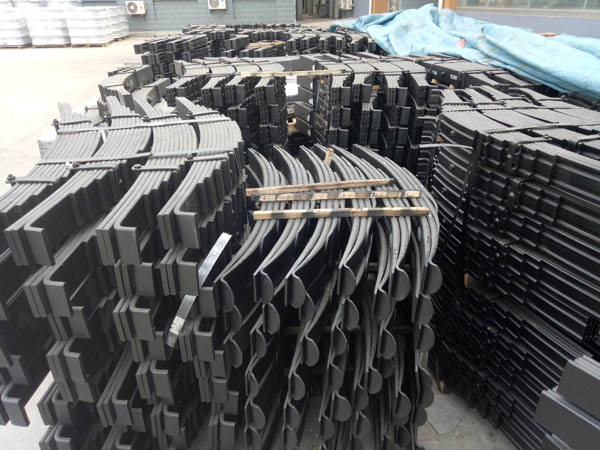
leafspringassembly leafspring
USD $123.00
/ 件
最小起订量: 1件
支持的贸易条款:
FOB
- 参考价格:
- USD $123.00
- 最小起订量:
- 1件
- 交货期:
- 20天
- 供货能力:
- 15,060件/周
- 装运港:
- shandong

- Main leaf: The longest top leaf with rolled eyes at both ends for hinged connection with frame hangers, bearing the main tensile force.
- Auxiliary leaves: Multiple spring‑steel plates with gradually reduced lengths stacked together to share loads.
- Center bolt: Fastens all spring steel plates into an integral unit to ensure synchronous deformation of each leaf.
- U‑bolts: Fasten the leaf‑spring assembly to the vehicle axle.
- Spring clips: Restrict lateral offset of spring leaves and prevent transverse shifting between plates.
- Eye bushings: Installed inside spring eyes, made of rubber or polyurethane, for friction buffering and abnormal noise reduction.
- Limit pads / bump stops: Limit the maximum compression travel of the leaf spring and prevent damage caused by direct hard collision of steel plates.
Core Materials and Manufacturing Processes
- Raw Material: High‑silicon‑manganese spring steel (such as 65Si2Mn), featuring high strength and excellent fatigue resistance, suitable for repeated bending deformation under heavy loads.
- Key Procedures:
- Blanking and stamping: Cut steel plates according to designed dimensions.
- Hot‑rolled eye forming: Heat‑process both ends of the main leaf to form mounting eyes.
- Quenching and tempering heat treatment: Improve steel strength and toughness to avoid fracture.
- Pre‑stressing treatment: Apply reverse stress in advance to extend fatigue service life.
- Shot peening: Surface treatment to eliminate micro‑cracks and improve fatigue resistance.
- Paint coating: Anti‑rust and anti‑corrosion protection against erosion from mud, water and gravel.
Main Functions
- Load‑bearing: Bear the weight of vehicle and cargo, serving as the major load‑bearing component for heavy‑duty vehicles.
- Shock absorption and buffering: Steel plates bend and deform under road bumps to absorb impact from road surfaces.
- Force transmission and guiding: Transfer driving and braking forces, constrain axle position, and realize positioning function without extra guiding mechanisms.
Application Scenarios
Heavy‑duty trucks, semi‑trailers, light‑duty trucks, passenger coaches, construction machinery and off‑road vehicles. Widely applied in cargo transportation, logistics and construction working conditions.
Advantages & Disadvantages
✅ Advantages
- High load‑bearing capacity and strong impact resistance, adaptable to heavy‑load and poor‑road‑surface conditions.
- Simple structure, low manufacturing cost, convenient inspection and field maintenance.
- Reliable force transmission; no complicated air supply system required.
⚠️ Disadvantages
- Inferior riding comfort compared with air‑spring suspension.
- Friction occurs between spring leaves; long‑term overloading may lead to leaf fracture.
- Large unsprung mass, not suitable for high‑speed lightweight transportation.
Installation & Maintenance Notes
- Regularly inspect leaf springs for cracks, deformation and rust; replace damaged parts in time.
- Tighten U‑bolts to specified torque value; avoid over‑tightening or insufficient fastening.
- Inspect spring clips and eye bushings; replace worn bushings to eliminate rattling noise.
- Avoid long‑term overloading, which will greatly shorten service life.
- Properly lubricate friction surfaces to reduce wear between spring leaves.
交易规格
- 参考价格
- USD $123.00
- 最小起订量
- 1件
- 交货期
- 20天
- 供货能力
- 15,060件/周
- 装运港
- shandong
支持的贸易条款:
FOB

基础商家
成立于 2010 年

山东水泊机电设备有限公司
山东水泊机电设备有限公司成立于2010年,位于山东省济宁市梁山县,占地面积30000平方米,拥有员工200余名。为客户提供专用车生产所需的焊丝、钢圈、悬架、储气筒、车桥、板簧、空气弹簧、卡钳、气室等配件。凭借卓越的产品性能和优质的服务,使专用车厂家既能买到优质配件,又能降低采购成本,实现一站式快捷服务。 水泊机电自产多种优质配件,同时也和国内外多家知名品牌合作代理,品质优良,供货及时,服务全面,让客户朋友买的放心,用的安心。 国内配套客户已经接近2000多家,其中包括中集集团、中国重汽、陕汽集团、大运集团、青特集团等国内知名企业。国际配套已经延伸到美洲、欧洲、非洲、亚洲、中东、东南亚等多个国家和地区,得到了广大客户的信赖和支持。已经建立起一个辐射全国和全球的专用车配件配套优质网络服务体系。
- 所在地
- 山东省济宁市梁山县拳铺镇工业园(220国道16号)
- 主营产品
- 商用车配件
- 员工人数
- 50 人以下
- 工厂面积
- 1,000-5,000 m²
- 年销售额
- 500 万 - 1000 万美元
- 主要市场
- 东南亚 / 南亚 / 中东与北非 / 非洲