
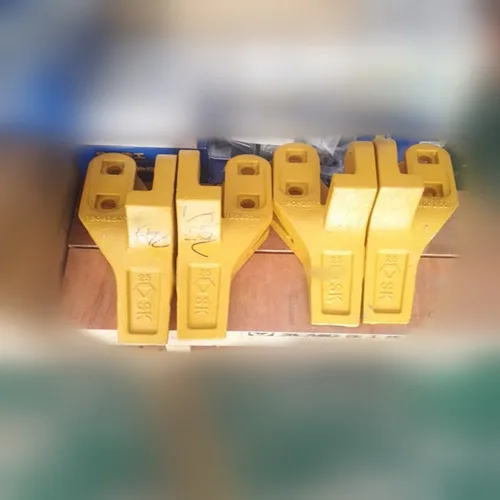
XCMG Spare: Right Side Bucket Tooth 252117635 | Z5GN.30-4, Loader Bucket Cutting Tooth
最小起订量: 1件
- Material code::
- 252117635
- Material Description::
- Z5GN.30-4 right tooth
- 参考价格:
- USD $34.00
- 最小起订量:
- 1件

产品特点与应用
This Right Side Bucket Tooth 252117635 is a cutting wear part at the right end of XCMG loaders' bucket working device, associated with drawing number Z5GN.30-4. Loader bucket teeth are the main wear parts of a loader, consisting of a tooth holder and a tooth tip joined by a pin—wear and failure occur mainly at the tooth tip, so only the tip needs replacement after wear .
A bucket tooth (also called shovel tooth, bucket tip, or ground engaging tool) is the core cutting wear part at the front edge of a loader bucket—equivalent to the loader's "teeth"—directly contacting soil, rock, ore, construction debris, and other materials to undertake the core tasks of digging, penetration, scraping, and breaking . A loader bucket tooth typically consists of two parts: a tooth holder (shank) and a tooth tip (point), joined and fixed by a pin; since wear and failure during operation occur mainly at the tooth tip, routine maintenance only requires replacing the tip while the holder can be used long-term .
Working-mechanism of bucket teeth in loading operations (based on public literature on construction-machinery design, as background reference for this part, not specific to this item):
-
Reducing penetration resistance: When the bucket edge is fitted with bucket teeth, the teeth penetrate the material pile before the cutting edge; because the teeth have a small contact area and high specific pressure, they penetrate the pile more easily than a toothless cutting edge, reducing insertion resistance by about 20%—especially significant when loading high-density, high-resistance materials .
-
Protecting the bucket body: As wear parts, bucket teeth bear the main abrasion and impact, preventing the bucket's front-edge blade from direct erosion and greatly extending the bucket's overall service life .
-
Improving operational precision: The pointed-penetration characteristic of bucket teeth gives the operator a clear reference baseline in fine operations, facilitating control of loading depth and angle .
Classification and selection by working condition (as general background, not specific to this part):
By operating environment, bucket teeth are generally divided into three categories: rock teeth (for high-abrasion hard-rock conditions such as iron mines and quarries), earth-moving teeth (for conventional earthwork such as soil and sand-gravel), and conical teeth (for specific materials such as coal mines); bucket-tooth shapes also vary by loader brand . By tooth-tip cross-section, common designs in the market include chisel tooth, rock chisel, single tiger-tooth, and double tiger-tooth variants—chisel teeth have a wide working face, good wear resistance, and leave a flat bottom in grading work, suiting general transport, grading, and trenching; rock chisels offer strong penetration, suiting hard-rock breaking .
Material and process differences: By manufacturing process, bucket teeth are mainly divided into cast teeth and forged teeth—forged teeth are generally more wear-resistant and harder, with a service life about twice that of cast teeth, while priced at about 1.5 times that of cast teeth . High-manganese steel (e.g., ZGMn13) has extremely strong wear resistance and a work-hardening effect, suiting hard rock and sand-gravel; alloy steel (e.g., 45#, 65Mn) has good toughness and impact resistance, suiting earthwork and loose materials . Tooth-tip hardness typically ranges from HRC 47–54, requiring a trade-off between wear resistance and impact resistance based on working conditions .
技术规格
- Material code:
- 252117635
- Material Description:
- Z5GN.30-4 right tooth
交易规格
- 参考价格
- USD $34.00
- 最小起订量
- 1件


徐州恒铭机械设备有限公司
徐州恒铭机械设备有限公司扎根徐州 —— 徐工品牌的发源地与全国工程机械核心产业聚集地,长期深耕徐工工程机械配件配套行业,具备正规进出口经营资质,是面向全球徐工设备使用者的一站式配件源头供应商。
- 所在地
- 徐州经济技术开发区三环东路淮海五金机电大市场一期 D32#-1-115(线下门店:淮海五金机电城 D32-115/116 门面,徐工道路北门 50 米)
- 主营产品
- 徐工全系备件
- 员工人数
- 50 人以下
- 工厂面积
- 1,000-5,000 m²
- 年销售额
- 100 万 - 500 万美元
- 主要市场
- 欧洲 / 中东与北非 / 非洲