

Introduction
The inside height of a standard semi trailer dry van is 110 inches (about 2.79 meters). This is the most common interior clearance in North American general freight service and the dimension that most palletized cargo is planned around. The figure is not universal: refrigerated trailers typically run lower because of insulation thickness, while high-cube or "Mega" trailers can reach approximately 3.0 meters through modified roof and floor design. The inside height therefore depends on trailer type, and the buyer's task is to match it to the cargo's stacking height and the clearance limits on the routes served.
Interior height matters because it sets the cubic capacity of the trailer, which determines how much light, bulky cargo can be carried per trip. A trailer that is 20 centimeters taller can carry an additional layer of some products, but it may also exceed bridge or tunnel clearances on certain routes. For procurement managers and fleet operators, interior height is an efficiency trade-off between cargo volume and regulatory compliance, not a specification to maximize.
This guide examines the interior height ranges by trailer type, the structural and regulatory factors that constrain them, and the selection considerations that determine whether a given height is appropriate for a fleet's cargo profile.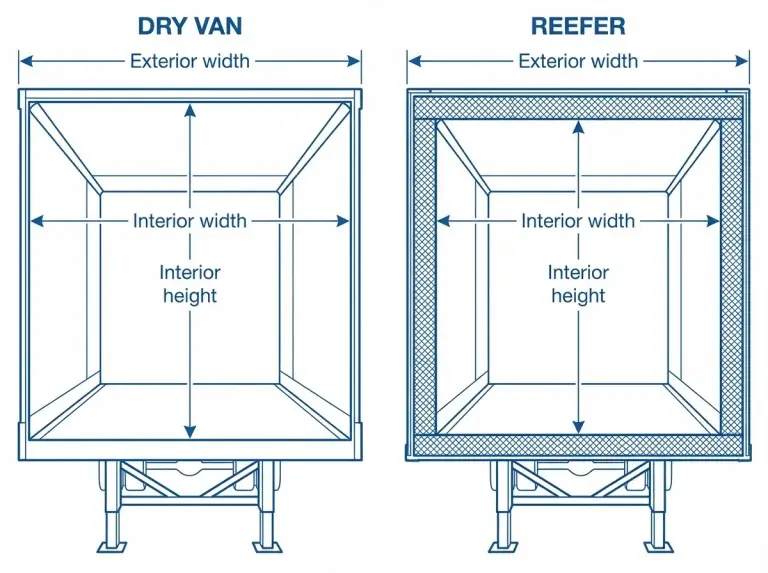
Core Powertrain and Structural Design
Engine and Transmission
A semi trailer has no engine or transmission, and its interior height is a purely structural parameter. It is determined by the trailer's external overall height limit—such as the 13 ft 6 in road limit common in the United States—minus the thickness of the roof, floor, and sidewall structure. Interior height directly affects loading volume, but it must first comply with road clearance regulations.
Hydraulic System
Standard enclosed trailers have no hydraulic system related to interior height. Only specialized trailers with lifting or tilting functions—such as some curtain-side or specialized cargo trailers—involve hydraulic mechanisms, and these are unrelated to the interior clear height of conventional dry vans.
Chassis and Structural Durability
Interior height is a measure of cargo cubic capacity, not a structural durability parameter. Increasing interior height in structural design typically means thinning the roof or lowering the floor through low-profile suspension, which may sacrifice structural strength or increase the risk of cargo damage. A slight front-to-rear difference in interior height is common on production trailers because floor flatness and structural reinforcement are not perfectly uniform along the length of the unit.
Technical Specifications
The table below summarizes representative interior height data for common semi trailer types. These values are typical industry ranges; actual specifications vary by manufacturer, model, and configuration, and purchase decisions should be based on the manufacturer's data sheet for the specific model.
| Key Parameter | Typical Technical Specification | Operational Significance |
|---|---|---|
| Standard dry van interior height (53 ft) | 110 in (approximately 2.79 m) | Most common standard; accommodates two-high pallet stacking in most configurations |
| Production dry van front/rear variation | Front 110-1/4 in, rear 111-1/4 in (example) | Minor front-to-rear difference reflects floor and structural design |
| Refrigerated trailer interior height | Approximately 2.60–2.65 m | Insulation thickness reduces interior clear height by roughly 15–20 cm |
| Curtain-side trailer interior height | Approximately 2.78 m | Close to dry van level; side loading access |
| High-cube or Mega trailer interior height | Approximately 3.0 m | Extra height for light bulky cargo; route clearance restrictions may apply |
| Exterior overall height (US standard) | 13 ft 6 in (4.11 m) | Regulatory ceiling that constrains achievable interior height |
Comparative Advantages TCO and ROI
The choice of interior height is a trade-off between cargo volume and regulatory compliance. A standard 110-inch interior height trailer can legally travel on most North American road networks, has good versatility, and retains broad resale liquidity. A high-cube or Mega trailer, while offering approximately 20 centimeters more interior height, may be restricted by bridge or tunnel clearances in some regions and can only operate on specific routes.
From a total cost of ownership perspective, the premium of a high-cube trailer must be offset by additional cargo revenue generated from the extra height. If the cargo is light but bulky—packaging materials, foam products, empty containers—the extra 20 centimeters may meaningfully increase the loading rate per trip. If the cargo is already limited by weight, higher interior height provides almost no economic benefit. Buyers should calculate the value of cubic capacity based on actual cargo density rather than simply pursuing the maximum interior height specification.
A defensible comparison requires stated assumptions. Consider a fleet hauling light bulky cargo where the trailer cubes out before it weighs out. If a high-cube trailer allows 10 percent more cargo per trip and the fleet runs 100 trips per year at 2,000 CNY revenue per trip, the additional revenue is 20,000 CNY per trailer per year. Against a price premium of 40,000 CNY, simple payback is two years—provided the routes permit high-cube operation without restriction. If the routes include low-clearance structures, the trailer's usability and payback change entirely.
Resale value favors standard heights. A 110-inch dry van has the broadest buyer pool. Mega trailers have a narrower market and may sit longer on the used lot, though they command premiums in specific niches where the extra height is essential.
Heavy Duty Application Scenarios
-
General freight and dry van operations: A 53 ft dry van with 110-inch interior height is the standard configuration. It accommodates most palletized goods, boxed products, and consumer goods. Two-high pallet stacking is feasible depending on pallet height.
-
Refrigerated and temperature-controlled freight: Reefer trailers carry food and pharmaceuticals under temperature control. The insulation required for thermal performance reduces interior height to approximately 2.60–2.65 m, which must be accounted for in load planning.
-
Light bulky cargo: Mega or high-cube trailers serve automotive parts, furniture, and empty container movements where cubic capacity matters more than weight. Route planning must verify bridge and tunnel clearances before committing to the configuration.
-
Curtain-side loading: Curtain-side trailers combine side-loading access with interior height similar to dry vans, suiting cargo that requires forklift access from the side rather than the rear.
Selection and Maintenance Considerations
Selecting interior height begins with the clearance restrictions on the transportation routes. Trailers with an external height of 13 ft 6 in are the standard configuration for US interstate highways, and their corresponding interior height is approximately 110 inches. If a taller interior is required, the impact on overall height must be assessed, along with whether special permits or route restrictions apply.
Key considerations include:
-
Measure cargo stacking height, not just trailer height. Determine the height of a single pallet or cargo unit and the required number of stacking layers. If three-layer stacking is needed, a Mega trailer may be required; if two layers fit, the standard 110-inch unit is sufficient.
-
Verify floor load capacity at higher stacking. Higher stacking increases point loads on the floor. Confirm that the floor's rated load capacity meets the requirement before committing to a high-stack loading pattern.
-
Confirm the actual interior height on the specific unit. Production tolerances and optional equipment can change the interior height by an inch or more. Obtain the manufacturer's data sheet for the exact model rather than relying on a nominal figure.
-
Consider resale liquidity. Standard 110-inch dry vans have the broadest market acceptance. Non-standard heights have a narrower buyer pool at resale but may be in short supply in specific niches, supporting a premium in those segments.
Conclusion
The interior height of a semi trailer is not a single number but an engineering parameter constrained by regulations, structural design, and cargo requirements. The standard dry van's 110 inches (2.79 meters) is the most common answer and meets the vast majority of general cargo transportation needs. Refrigerated trailers are slightly lower because of insulation requirements, while Mega trailers can reach approximately 3.0 meters at the cost of route flexibility.
When making procurement decisions, buyers should start from the actual cargo's stacking height and route clearance restrictions rather than simply pursuing the maximum value. The trailer whose interior height fits the cargo, the floor load rating, and the clearance envelope on the route is the one that delivers cubic capacity without compliance surprises.