

Introduction
The transportation of exceptionally long industrial components creates challenges that conventional semi trailers cannot always address. Wind turbine blades, bridge sections, structural steel, long pipes, railway components, and other oversized cargo may require specialized trailers with extended platforms, multiple axle groups, and advanced steering arrangements.
The world’s longest semi trailer is not a single universally defined category. Maximum length depends on whether the discussion concerns a conventional road-legal semi trailer, an extendable low-loader, a specialized heavy-haulage combination, or a purpose-built transport system operating under special permits.
Some of the longest road transport configurations use modular equipment and multiple steering axles rather than a single conventional trailer frame. Their overall length, payload, and operating conditions depend on the cargo, tractor configuration, route, local regulations, and permit conditions.
For fleet managers and heavy-haulage operators, extreme trailer length is not automatically an advantage. The real objective is to transport long cargo safely while maintaining acceptable axle loads, maneuverability, structural reliability, and operating costs.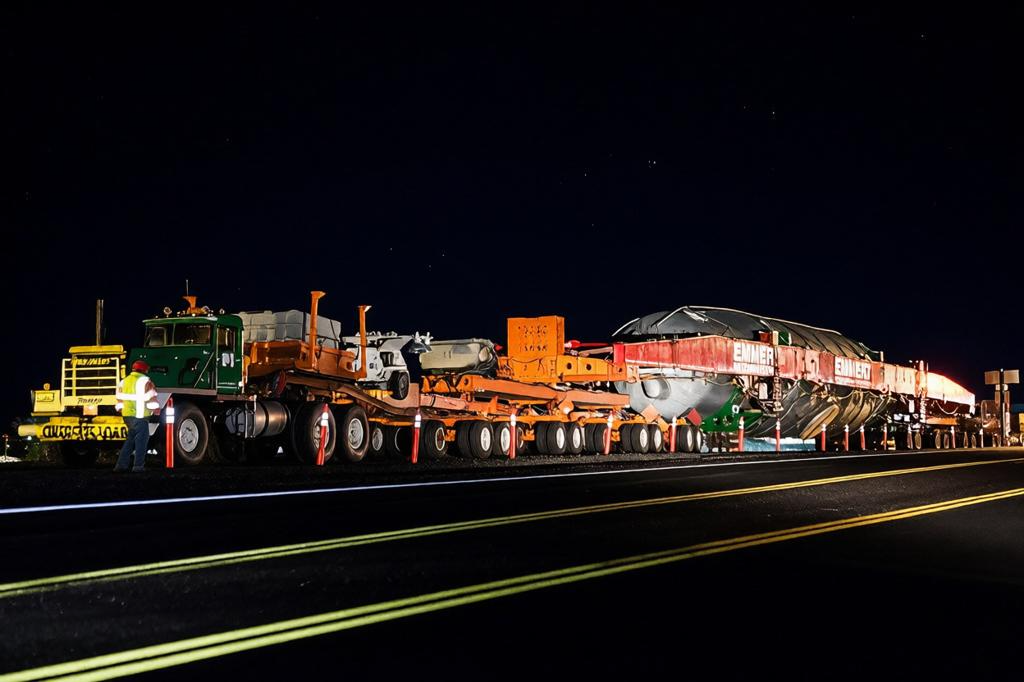
Core Powertrain and Structural Design
An extra-long semi trailer places different demands on the tractor, coupling system, chassis, suspension, and steering equipment. The complete combination must be engineered as one transport system.
Tractor Engine and Transmission
A semi trailer does not normally have its own main propulsion engine. It relies on the tractor unit to provide traction and braking coordination.
For long and heavy transport combinations, tractor selection should consider:
-
Engine power and maximum torque.
-
Transmission gear ratios and low-speed control.
-
Gross combination weight rating.
-
Fifth-wheel and coupling compatibility.
-
Engine cooling capacity under sustained load.
-
Retarder or auxiliary braking capability, where fitted.
The required engine output depends on total combination mass, gradients, rolling resistance, road surface, and operating speed. A longer trailer carrying a relatively light load may have different power requirements from a shorter heavy-haulage trailer carrying concentrated loads.
Transmission selection is equally important. Heavy-duty automated manual and manual transmissions can provide different control characteristics, while low-speed maneuvering and gradient starts require suitable gearing.
Hydraulic and Steering Systems
Extreme-length trailers may use multiple steering axles to reduce tire scrub and improve maneuverability.
Common steering arrangements include:
-
Self-steering axles: Use mechanical or hydraulic mechanisms to respond to changes in direction.
-
Hydraulically steered axles: Allow controlled steering through hydraulic cylinders and linkages.
-
Electronically controlled steering: Uses sensors and control systems to coordinate steering angles across multiple axle groups.
-
Remote-controlled steering: May be used in certain specialized heavy-haulage configurations.
The appropriate arrangement depends on trailer length, axle spacing, turning requirements, transport speed, and route conditions.
Hydraulic systems may also operate suspension height adjustment, loading ramps, extendable sections, and other specialized equipment. Hydraulic pressure, flow capacity, cylinder sizing, hose routing, and service access should be matched to the intended duty cycle.
Chassis and Structural Durability
The chassis is one of the most important engineering elements of an extra-long semi trailer.
A conventional trailer frame may be unsuitable for unusually long cargo because bending moments and deflection increase with unsupported length and load distribution.
Design considerations include:
-
Main beam section and material strength.
-
Crossmember spacing and reinforcement.
-
Kingpin and fifth-wheel load transfer.
-
Axle-group positioning.
-
Deck height and ground clearance.
-
Load restraint and tie-down locations.
-
Fatigue resistance under repeated road loading.
Extendable trailers use sliding or telescoping frame sections to accommodate different cargo lengths. These mechanisms require secure locking arrangements and structural verification in every permitted operating position.
For extremely long loads, modular trailer combinations may provide more flexibility than a single extended chassis.
Suspension, Axles, and Braking
Multiple axle groups distribute the trailer load across more tires and help manage individual axle loads. Depending on the trailer design, suspension may be mechanical, air-suspended, hydraulic, or part of a modular platform system.
Air suspension can provide ride-height adjustment and load management, while hydraulic suspension systems are commonly used in specialized heavy-haulage equipment requiring coordinated load distribution and ground-clearance control.
Braking systems must be compatible with the tractor and the applicable vehicle regulations. Pneumatic service brakes, ABS, and electronic braking systems may be incorporated depending on the market and vehicle configuration.
A long trailer combination also requires careful brake balance. The braking response of the tractor and trailer must remain coordinated under different loading and road conditions.
Operator Safety and Serviceability
Long trailers create additional blind spots, turning challenges, and risks during reversing and cornering.
Safety provisions may include:
-
Appropriate lighting and conspicuity markings.
-
Camera and monitoring systems.
-
Clearly identified loading and tie-down points.
-
Secure extension-section locking mechanisms.
-
Accessible emergency and maintenance controls.
-
Suitable braking and steering monitoring systems.
Maintenance access is especially important when a trailer has numerous axle groups, steering cylinders, hydraulic lines, and electrical connections. Components should be arranged so that inspections and repairs can be completed without unnecessary dismantling.
Technical Specifications
The specifications of the world's longest semi trailer cannot be represented by one universal set of figures. A conventional long trailer, an extendable low-loader, and a modular heavy-haulage platform have different engineering requirements.
The following table identifies the main parameters buyers and transport engineers should evaluate. Actual dimensions and ratings must be confirmed from the selected manufacturer's technical documentation and the applicable transport approval.
|
Key Parameter |
Typical Technical Specification |
Operational Significance |
|---|---|---|
|
Overall length |
Configuration- and permit-dependent |
Determines route access and turning requirements |
|
Deck length |
Fixed or extendable design |
Defines the usable cargo-supporting area |
|
Payload capacity |
Manufacturer-rated and axle-load dependent |
Determines the maximum permitted cargo weight |
|
Axle configuration |
Multiple axle groups as required |
Distributes load across the trailer |
|
Steering system |
Fixed, self-steering, hydraulic, or electronic |
Influences maneuverability and tire wear |
|
Suspension |
Mechanical, air, or hydraulic |
Affects load distribution, ride height, and stability |
|
Braking system |
Pneumatic, ABS, or electronic systems as applicable |
Supports controlled and coordinated braking |
|
Deck height |
Design- and suspension-dependent |
Affects cargo clearance and overall transport height |
Understanding Length and Payload
Overall length and usable deck length are different measurements. Overall length includes the complete trailer structure and relevant projections, while deck length describes the space available for supporting cargo.
For long cargo, buyers should also consider the load's center of gravity, overhang, support-point spacing, and restraint arrangement. A long platform does not automatically mean that the trailer can carry every long component safely.
Payload capacity must be evaluated alongside axle ratings, tire load limits, kingpin loading, tractor capacity, and legal gross vehicle limits. A trailer's structural rating alone does not establish the permitted weight of the complete combination.
Comparative Advantages TCO and ROI
Extra-long semi trailers offer advantages for transporting cargo that cannot be accommodated by standard trailer dimensions. However, the appropriate solution depends on cargo frequency, route conditions, loading requirements, and regulatory restrictions.
Extra-Long Semi Trailer vs. Conventional Flatbed
A conventional flatbed is generally easier to operate and more widely compatible with ordinary freight routes. It can be suitable for standard construction materials, machinery, and general cargo.
An extra-long trailer provides more usable deck length or supports longer loads, but it may require:
-
Special transport permits.
-
Route surveys and infrastructure checks.
-
Escort vehicles where required.
-
More complex turning and reversing procedures.
-
Additional steering and suspension maintenance.
For occasional oversized cargo, hiring specialized transport may be more economical than purchasing an extra-long trailer.
Extra-Long Semi Trailer vs. Extendable Trailer
An extendable semi trailer can adjust its platform length to suit different cargo dimensions. This flexibility may improve utilization when a fleet transports loads of varying lengths.
However, extension mechanisms add structural and maintenance requirements. Locking systems, sliding components, hydraulic equipment, and electrical connections need regular inspection.
A fixed-length trailer may be preferable when the cargo dimensions remain consistent and the route does not require frequent changes in configuration.
Extra-Long Semi Trailer vs. Modular Heavy-Haulage Platform
Modular platform trailers can be configured with different axle lines and deck arrangements to handle specialized loads.
Their main advantage is flexibility in load distribution and transport configuration. They are particularly relevant for large industrial equipment, infrastructure components, and exceptionally heavy cargo.
The trade-offs include higher equipment complexity, specialized operators, configuration planning, and potentially greater mobilization costs.
Total Cost of Ownership
The total cost of ownership (TCO) of an extra-long semi trailer includes more than the initial purchase price.
Important cost categories include:
-
Trailer purchase and financing.
-
Tractor compatibility and operating costs.
-
Tire replacement and suspension maintenance.
-
Steering and hydraulic system maintenance.
-
Brake inspections and component replacement.
-
Special permits and route surveys.
-
Escort and traffic-management costs where required.
-
Driver training and specialized transport labor.
-
Downtime and spare-parts availability.
The financial comparison should use the expected annual number of trips, average cargo dimensions, route distances, permit costs, maintenance expenses, and trailer utilization.
Return on Investment
An extra-long semi trailer may improve fleet efficiency when a business regularly transports cargo that would otherwise require alternative equipment or multiple transport arrangements.
For example, a company regularly moving long steel structures could compare the annual cost of owning an extendable trailer with the cost of hiring specialized transport for the same cargo volume.
The comparison should use consistent assumptions for annual trips, cargo dimensions, loading time, empty return mileage, permits, labor, maintenance, and financing.
There is no guaranteed payback period. A specialized trailer may be commercially attractive for frequent, predictable work but uneconomical for occasional oversized loads.
Heavy Duty Application Scenarios
The longest semi trailers and specialized extended transport combinations are used in applications where cargo dimensions exceed the practical capacity of standard trailers.
Wind Energy and Renewable Infrastructure
Wind turbine blades and other renewable-energy components can be exceptionally long and difficult to transport.
Specialized blade trailers may use extendable structures, steering axles, and lifting or tilting mechanisms to navigate restricted routes.
Important considerations include:
-
Blade length and support locations.
-
Overall vehicle height and width.
-
Road curvature and turning radius.
-
Overhead power lines and bridges.
-
Wind conditions during transport.
-
Loading and unloading arrangements.
A purpose-built blade transport system may be more suitable than a conventional long flatbed.
Bridge and Infrastructure Construction
Large bridge sections, precast structural elements, and long steel components may require extended transport platforms.
The trailer must distribute the load across suitable support points while maintaining structural stability. Route planning is particularly important where bridges, road surfaces, roundabouts, and construction access roads create restrictions.
Oil, Gas, and Industrial Projects
Pipelines, processing equipment, long pressure-vessel components, and industrial structures may require specialized transport combinations.
The trailer configuration should match the cargo's length, mass, center of gravity, and lifting arrangements. Some loads require modular axle-line systems rather than a single extra-long trailer.
Railway and Port Infrastructure
Railway components, long structural beams, and port equipment may require extended trailers for movement between manufacturing facilities, ports, storage areas, and installation sites.
In these operations, loading access, turning space, ground-bearing capacity, and coordination with lifting equipment can be as important as the trailer's nominal deck length.
Heavy Industrial Machinery
Certain large machinery assemblies have dimensions that exceed ordinary road transport limits. Extendable trailers and modular platforms can provide the required support area while allowing the transport configuration to be adapted to the load.
The equipment should be selected according to the actual cargo envelope and route, rather than choosing the longest available trailer without considering operating restrictions.
Selection and Maintenance Considerations
Choosing an extra-long semi trailer requires a detailed assessment of cargo requirements, road regulations, tractor compatibility, and maintenance capability.
Define the Cargo Requirements
Before selecting equipment, establish the maximum cargo dimensions and weight.
Key information includes:
-
Cargo length, width, and height.
-
Total cargo weight.
-
Center of gravity.
-
Required support-point locations.
-
Loading and unloading method.
-
Expected overhang.
-
Frequency of transport.
-
Whether cargo dimensions vary between trips.
This information determines whether a fixed-length, extendable, or modular trailer is appropriate.
Verify Road Regulations and Route Restrictions
Maximum permitted vehicle dimensions and axle loads vary by country and jurisdiction. Special permits may be required for oversized transport, and certain routes may have restrictions on bridges, tunnels, road geometry, or overhead infrastructure.
Before purchasing, verify:
-
Legal overall combination length.
-
Permitted trailer and cargo dimensions.
-
Maximum axle and gross combination weights.
-
Permit and escort requirements.
-
Bridge and road load restrictions.
-
Turning radius and access limitations.
-
Applicable lighting and marking requirements.
A trailer that can physically carry a load is not necessarily permitted to transport it on every public road.
Check Tractor and Trailer Compatibility
The tractor must be compatible with the trailer's kingpin, fifth wheel, gross combination requirements, braking system, electrical connections, and hydraulic or electronic controls.
For specialized heavy-haulage combinations, the tractor's traction, engine torque, transmission, braking capacity, and cooling performance should be evaluated against the actual loaded operating conditions.
Inspect Structural and Mechanical Components
A preventive maintenance program should include:
-
Main frame and crossmember inspection.
-
Extension-section locking mechanism checks.
-
Kingpin and fifth-wheel inspection.
-
Axle, wheel, and tire condition checks.
-
Suspension and ride-height system inspections.
-
Steering-cylinder and hydraulic-hose inspections.
-
Brake-system testing and adjustment.
-
Electrical connections and lighting checks.
-
Inspection of tie-down points and cargo restraints.
Long trailers may experience different stress patterns from conventional equipment, particularly when carrying unevenly distributed loads or operating on irregular roads.
Evaluate Supplier Support
Buyers should request complete technical documentation before placing an order.
Useful documents include:
-
General arrangement and dimensional drawings.
-
Maximum payload and axle-load ratings.
-
Extension-range information.
-
Steering and suspension specifications.
-
Braking-system details.
-
Tractor compatibility requirements.
-
Maintenance schedules.
-
Applicable road approval and conformity documentation.
After-sales support is particularly important for specialized trailers because steering, hydraulic, suspension, and extension components may not be available through ordinary trailer repair facilities.
Conclusion
The world's longest semi trailers represent specialized solutions for transporting exceptionally long industrial cargo. Their engineering involves much more than extending a conventional trailer frame. Structural strength, axle-load distribution, steering geometry, suspension, braking, tractor compatibility, and road regulations must all be considered together.
For fleet operators, the best trailer is not necessarily the longest available model. It is the configuration that safely accommodates the intended cargo, complies with the relevant transport regulations, and provides reliable performance across the planned routes.
A careful comparison of fixed-length trailers, extendable semi trailers, and modular heavy-haulage platforms helps buyers balance transport capability, operating complexity, maintenance costs, and long-term fleet value.