

Introduction
Transporting a Chevrolet Corvette under a semi trailer raises an important engineering question: is there enough vertical and horizontal clearance to accommodate the sports car without damaging its bodywork, underbody, or aerodynamic components? The answer depends on the specific Corvette generation, the trailer's structural design, its loaded ride height, suspension position, and the intended loading method.
A Corvette is a low-profile sports car with a relatively low front splitter, limited ground clearance, and a long body compared with many passenger vehicles. These characteristics make loading geometry and clearance particularly important. A trailer that appears tall enough for a vehicle may still have insufficient clearance around its axles, suspension components, crossmembers, landing gear, or other structural elements.
The phrase Corvette under semi trailer can describe two different situations:
-
Vehicle clearance: Determining whether a Corvette can physically pass underneath a semi trailer or its elevated chassis.
-
Vehicle transportation: Determining whether a Corvette can be loaded onto or transported by a semi trailer, such as a car carrier or enclosed vehicle transport trailer.
These situations require different measurements and safety checks. The most reliable approach is to measure the actual vehicle and trailer rather than relying on general trailer dimensions.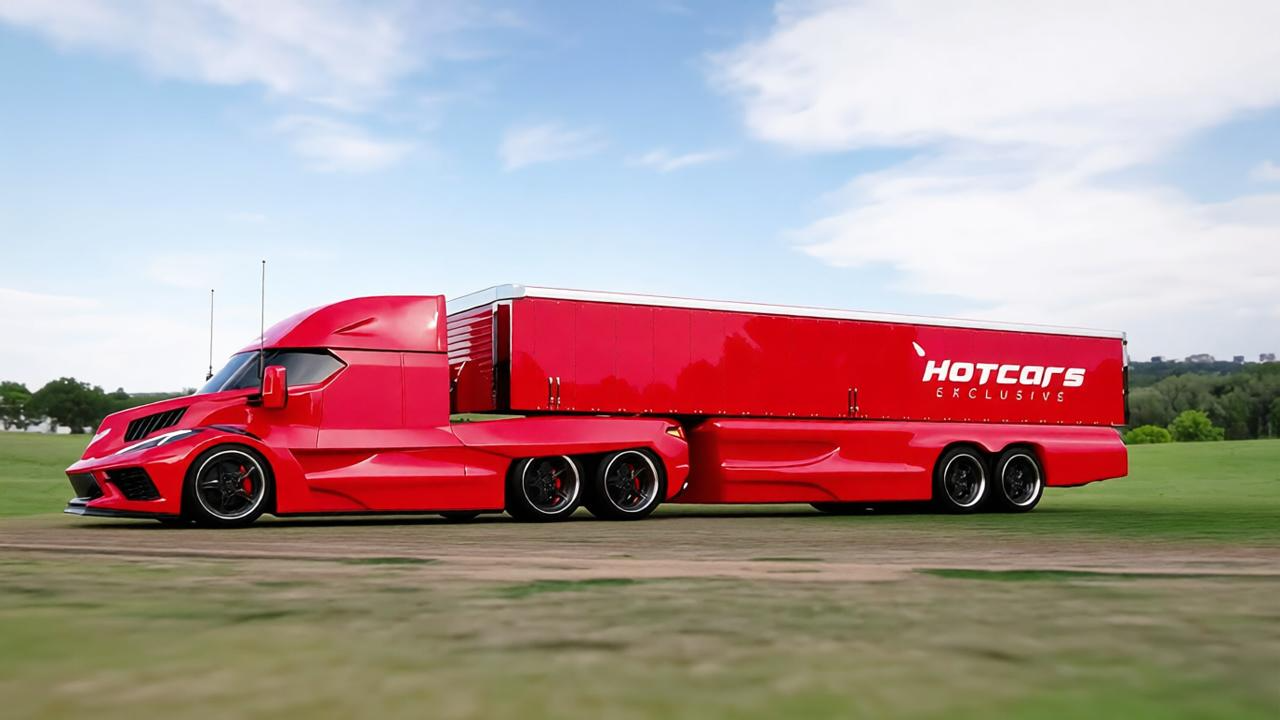
Core Powertrain and Structural Design
When evaluating a Corvette for transportation beneath or inside a semi trailer, the main engineering concerns are vehicle geometry, trailer structure, suspension, and loading equipment. Unlike conventional cargo, a low sports car requires careful handling to prevent contact between the vehicle and the trailer.
Corvette Vehicle Dimensions and Ground Clearance
The Corvette's overall dimensions vary by generation, model year, trim, suspension package, and optional aerodynamic equipment. A standard road-going model may have different clearance requirements from a high-performance version equipped with a front splitter or other low-mounted components.
Important vehicle measurements include:
-
Overall length: Determines the required loading deck length and parking space.
-
Overall width: Determines whether the vehicle can pass through the available opening or fit between trailer structures.
-
Overall height: Establishes the minimum vertical clearance requirement.
-
Ground clearance: Determines whether the front splitter, chassis, exhaust system, or underbody can clear ramps and structural obstacles.
-
Wheelbase: Affects the vehicle's approach and departure angles when moving over ramps.
-
Front and rear overhang: Influences the risk of scraping during loading and unloading.
Ground clearance is especially important because the lowest point of a Corvette may be lower than the main chassis reference point. Measuring only the vehicle's roof height or published overall dimensions is not sufficient for a safe transport assessment.
Semi Trailer Chassis and Suspension
A semi trailer uses a structural chassis to support its cargo and transfer loads through the suspension and axles to the road. The available clearance beneath the trailer depends on several factors.
Key components include:
-
Main frame rails: Longitudinal structural members that support the trailer deck and cargo loads.
-
Crossmembers: Transverse supports connecting the main frame rails.
-
Axle assemblies: Their position and configuration influence the available space beneath the trailer.
-
Suspension system: Air suspension or mechanical suspension affects ride height and load response.
-
Landing gear: Supports the front of the trailer when disconnected from the tractor.
-
Underride protection: Safety structures may occupy space beneath the trailer and restrict access.
A low-deck or specialized trailer may offer a different clearance profile from a conventional flatbed or dry van. However, lowering a trailer does not automatically create enough space for a Corvette to pass beneath it.
Loading Ramps and Vehicle Protection
If the Corvette is being transported on a semi trailer, the loading system must accommodate its low ground clearance.
A steep ramp can cause the front splitter or underbody to contact the ramp surface even when the trailer deck itself is sufficiently high. The same issue can occur when the rear wheels reach the deck while the front wheels are still on the ramp.
Suitable loading arrangements may include:
-
Long, gradual loading ramps.
-
Low-angle hydraulic loading platforms.
-
Adjustable suspension systems where supported by the trailer design.
-
Wheel skates or specialized vehicle-positioning equipment.
-
Protective loading surfaces and properly positioned wheel guides.
The correct arrangement depends on the Corvette's approach angle, departure angle, wheelbase, tire dimensions, and lowest underbody point.
Structural Durability and Operator Safety
A semi trailer must maintain its structural integrity while carrying the vehicle. Operators should never assume that an opening beneath the trailer is suitable for vehicle access simply because the Corvette appears small enough to fit.
The trailer's frame, axle arrangement, suspension components, and safety equipment must remain unobstructed. Any modification that changes the chassis, removes protective components, or compromises structural members requires appropriate engineering assessment and regulatory approval.
During loading, the trailer should be positioned on a stable surface and secured against unintended movement. Operators should also verify that the tractor and trailer are properly coupled or that the trailer is independently supported according to the loading procedure.
Technical Specifications
A reliable clearance assessment requires measurements from both the Corvette and the semi trailer. The following table identifies the main parameters to check. These are measurement requirements, not official specifications for a particular Corvette or trailer model.
|
Key Parameter |
Specification to Verify |
Operational Significance |
|---|---|---|
|
Vehicle overall height |
Actual roof height in transport configuration |
Determines vertical clearance |
|
Vehicle overall width |
Widest body or mirror position |
Determines available passage width |
|
Vehicle overall length |
Actual bumper-to-bumper length |
Determines loading and parking space |
|
Ground clearance |
Lowest underbody point |
Reduces risk of scraping |
|
Trailer underbody clearance |
Lowest structural or mechanical component |
Determines whether the car can pass underneath |
|
Ramp angle |
Actual loading ramp inclination |
Affects approach and departure clearance |
|
Trailer payload capacity |
Manufacturer-rated payload |
Confirms permitted cargo weight |
|
Axle and suspension configuration |
Actual trailer specification |
Affects clearance, load distribution, and stability |
Understanding Vertical Clearance
Vertical clearance is the distance between the ground and the lowest obstruction beneath the trailer. It must be measured at the exact location where the Corvette is expected to pass.
A useful assessment considers:
-
The trailer's unloaded ride height.
-
Its loaded ride height.
-
The lowest point of the frame, axle, suspension, or protective equipment.
-
Ground irregularities and changes in surface elevation.
-
The additional clearance needed for safe movement.
A trailer that provides sufficient clearance when empty may offer less clearance after cargo is loaded. Suspension movement and tire deflection can also change the available space.
Understanding Loading Angles
A vehicle's approach angle describes its ability to move onto an inclined surface without the front contacting the ground or ramp. Its departure angle describes the corresponding clearance at the rear.
The breakover angle is another important measurement. It describes the vehicle's ability to cross a crest without its underbody contacting the surface.
These measurements are particularly relevant to the Corvette because its low front aerodynamic components can contact ramps even when the vehicle's central ground clearance appears adequate.
Trailer Compatibility and Weight
If the Corvette is being carried on a semi trailer rather than driven underneath it, the trailer must also meet the vehicle's weight and securement requirements.
The assessment should include:
-
Actual vehicle curb weight and transport configuration.
-
Trailer payload rating and axle capacity.
-
Load distribution across the trailer axles.
-
Tire load ratings and inflation requirements.
-
Wheel chock and tie-down compatibility.
-
Applicable vehicle securement regulations.
The trailer manufacturer's specifications and the actual vehicle measurements should be used for the final compatibility decision.
Comparative Advantages TCO and ROI
Different semi trailer configurations offer different advantages for transporting a low-clearance sports car. The most appropriate choice depends on whether the objective is to carry the Corvette, provide temporary shelter, or create enough physical space for the vehicle to pass beneath the trailer.
Conventional Flatbed vs. Low-Deck Trailer
A conventional flatbed semi trailer offers an open loading area and relatively straightforward access for suitable cargo. However, its deck height and loading ramp arrangement may make it less convenient for low-clearance vehicles.
A low-deck trailer can reduce the height between the road surface and the loading platform. This may improve loading geometry, depending on the trailer design and the Corvette's dimensions.
|
Trailer Type |
Main Advantage |
Main Consideration |
|---|---|---|
|
Standard flatbed |
Open access and flexible cargo arrangement |
Loading angle may be unsuitable |
|
Low-deck trailer |
Lower loading platform on suitable designs |
Ground clearance and axle geometry must be checked |
|
Enclosed car hauler |
Weather protection and controlled vehicle transport |
Internal height, ramp angle, and payload limitations |
|
Specialized vehicle carrier |
Designed for vehicle loading and positioning |
Requires configuration-specific compatibility checks |
Total Cost of Ownership
The total cost of ownership (TCO) includes more than the initial trailer purchase price. It covers the cost of operating, maintaining, and using the equipment throughout its service life.
For Corvette transportation, important cost factors include:
-
Trailer purchase or rental cost.
-
Loading and unloading equipment.
-
Fuel consumption and route distance.
-
Tire and suspension maintenance.
-
Insurance and cargo protection.
-
Labor and vehicle handling time.
-
Inspection and compliance costs.
-
Potential damage caused by unsuitable loading arrangements.
A specialized car carrier may require a higher initial investment than a conventional flatbed, but it may provide more suitable loading features for low-clearance vehicles.
ROI Considerations
Return on investment depends on transport frequency, vehicle value, operating costs, and the number of vehicles handled.
For example, a transport operator regularly moving expensive sports cars may find that a specialized vehicle carrier is commercially preferable if it reduces handling time and lowers the risk of loading damage. The financial benefit should be calculated using actual purchase costs, annual utilization, maintenance expenses, insurance costs, and revenue per transport.
There is no universal savings percentage. A specialized trailer is only economically justified when its additional capabilities support sufficient transport demand or reduce measurable operating risks.
Heavy Duty Application Scenarios
Although a Corvette is a passenger sports car rather than heavy machinery, semi trailers are commonly used to transport high-value vehicles over long distances. Different transport applications require different trailer configurations and handling procedures.
Enclosed Sports Car Transportation
An enclosed car hauler is often suitable when the objective is to protect a Corvette from road debris, weather, and external exposure.
Important considerations include:
-
Internal trailer height and width.
-
Door and ramp opening dimensions.
-
Loading platform height.
-
Vehicle tie-down locations.
-
Interior protection and ventilation.
-
Payload capacity and axle loading.
The trailer must accommodate the complete vehicle, including mirrors and any installed aerodynamic components.
Open Car Carrier Transportation
Open vehicle carriers can transport sports cars when the loading deck, ramp geometry, and securement arrangements are compatible.
Operators should verify that the Corvette can be positioned without contacting adjacent vehicles, structural supports, or loading equipment.
Vehicle spacing is particularly important when multiple cars are transported on the same trailer.
Passing a Corvette Under a Parked Semi Trailer
If the objective is to drive a Corvette underneath a stationary semi trailer, the relevant issue is physical clearance rather than cargo capacity.
Before attempting this, verify:
-
The lowest point of the trailer structure.
-
The actual roof height of the Corvette.
-
The trailer's suspension position and loading condition.
-
Ground slope and surface irregularities.
-
Any protruding landing gear, axle, or protective components.
-
Whether the trailer is securely parked and supported.
A visual estimate is not sufficient. The vehicle should not be driven underneath unless adequate clearance has been measured across the entire intended path.
Vehicle Storage and Workshop Applications
A semi trailer may also be used as a temporary storage or mobile workshop space for high-value vehicles. In this situation, internal dimensions, ventilation, access doors, floor capacity, and environmental protection become important.
The Corvette should be stored on a stable surface with adequate space for opening doors and performing routine inspections.
Selection and Maintenance Considerations
Choosing the right semi trailer for Corvette transportation requires more than checking the trailer's advertised dimensions. Vehicle geometry, loading equipment, payload, structural condition, and operational procedures must all be evaluated.
Trailer Selection Checklist
Before purchasing or renting a trailer, verify the following:
-
Vehicle dimensions: Measure the Corvette's actual length, width, height, and lowest ground-clearance point.
-
Loading geometry: Check ramp length, ramp angle, platform height, and approach clearance.
-
Trailer clearance: Measure the lowest point of the trailer structure and mechanical components.
-
Payload capacity: Confirm that the trailer can legally and safely carry the vehicle.
-
Axle configuration: Verify axle ratings, suspension capacity, and load distribution.
-
Securement equipment: Confirm that suitable wheel restraints and tie-down systems are available.
-
Transport environment: Consider weather exposure, road conditions, and route restrictions.
-
After-sales support: Check parts availability, maintenance support, and warranty coverage.
Preventive Trailer Maintenance
A semi trailer used for vehicle transportation should be inspected regularly to maintain structural integrity and operational safety.
Key maintenance tasks include:
-
Inspecting the chassis and crossmembers for cracks, corrosion, or deformation.
-
Checking tires for wear, damage, and correct inflation.
-
Inspecting wheel bearings, brakes, and axle assemblies.
-
Checking suspension components and air lines where fitted.
-
Testing hydraulic ramps and lifting systems where applicable.
-
Inspecting tie-down points and wheel restraints.
-
Confirming that lighting, reflectors, and safety equipment function correctly.
Maintenance intervals should follow the trailer manufacturer's recommendations and applicable regulations.
Protecting the Corvette During Loading
Low-clearance vehicles require a controlled loading procedure. Operators should avoid sudden acceleration, sharp steering inputs, and uncontrolled movement on ramps.
Practical precautions include:
-
Inspect the loading surface for debris and uneven sections.
-
Confirm that the ramp is correctly positioned and secured.
-
Approach the ramp slowly and maintain a straight vehicle path.
-
Use a spotter when visibility or clearance is limited.
-
Check the front splitter and underbody throughout the loading process.
-
Position the vehicle according to the trailer's approved load distribution plan.
-
Secure the vehicle using suitable restraints at approved locations.
-
Recheck securement after the initial period of travel.
For high-value Corvettes, professional vehicle transport equipment and experienced operators can help reduce handling risks.
Regulatory and Compliance Considerations
Commercial vehicle transportation must comply with applicable road regulations, trailer weight limits, cargo securement requirements, and vehicle safety rules.
In the United States, relevant requirements may include Federal Motor Carrier Safety Administration cargo securement rules under 49 CFR Part 393, as applicable to the operation. State requirements may also govern vehicle dimensions, axle weights, and permitted routes.
Trailer modifications should be evaluated by qualified professionals to ensure that structural integrity and required safety equipment are not compromised.
Conclusion
Determining whether a Corvette can fit under a semi trailer requires accurate measurements of both the vehicle and the trailer. The most important factors are vertical clearance, ground slope, suspension position, structural obstructions, and the Corvette's low front and underbody components.
If the goal is to transport the Corvette, a suitable low-deck or specialized car carrier may provide a safer and more practical solution than a conventional trailer, provided its loading geometry, payload, and securement systems are compatible.
For buyers and transport operators, the best decision is based on verified dimensions, manufacturer specifications, safe loading procedures, and total operating costs. A careful compatibility assessment helps protect valuable vehicles, reduce handling risks, and ensure reliable semi trailer operation.